What Is a Good CIBIL Score for Personal Loan Approval in India? (2026 Guide)
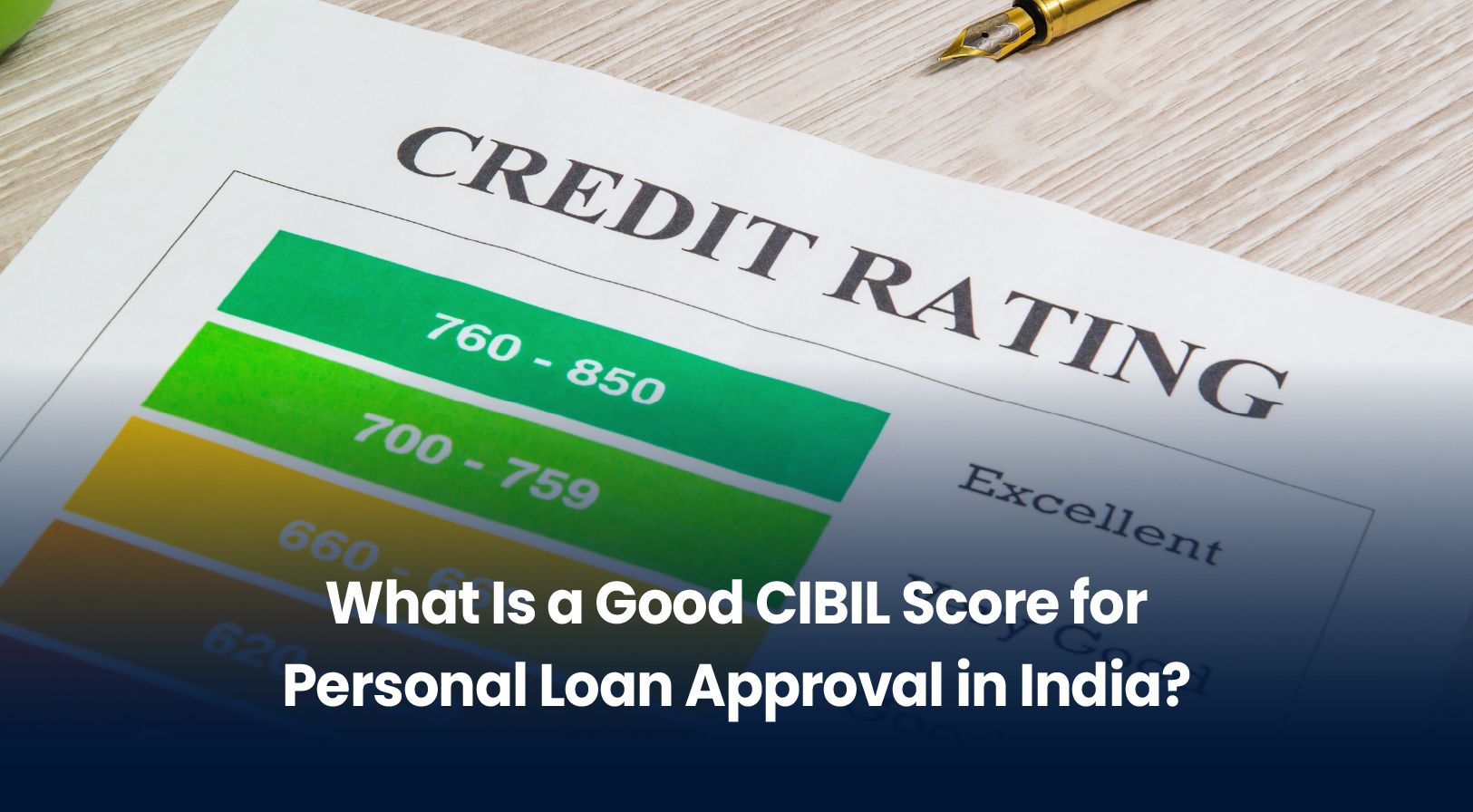
One of the strongest financial figures in your life is your CIBIL score. Be it in a personal loan application, in the application for a credit card, in the purchase of a car, or even in the negotiation of a lower interest rate, this three-digit score can influence virtually every lending decision of banks and NBFCs.
Nevertheless, what nearly all borrowers will ask themselves is: What is a good CIBIL score to borrow personal loans in India?
Even more to the point, what is the impact of your score on what you are approved, interest rate, loan amount, and speed of processing?
It is a comprehensive guide that explains all that you need to know about CIBIL scores in 2026, their ideal score ranges, lenders’ expectations, advantages of having a high score iandthe practical ways of qualifying despite having a low score.
1. What Is a CIBIL Score? Why Does It Matter?
CIBIL score is a three-digit credit score out of 300 to 900 that is developed by TransUnion CIBIL. It indicates your credit background, how well you pay, your debts and how well you spend money.
Here’s why lenders rely on it:
- It predicts your creditworthiness.
- It shows the likelihood of repaying the loan promptly.
- It assists the lenders in determining the riskiness of the loan.
- It defines your rate of interest and eligibility to take a loan.
A high score is an indicator of lower risks, whereas a bad score is a warning to the lender that you are likely to become defaulted or fail to control debts.
2. What is a Good CIBIL Score to get a Personal Loan? (2026 Edition)
The criteria of the various banks and NBFCs differ slightly; however, the common standard is similar throughout India.
CIBIL Score Range & Approval Likelihood
| CIBIL Score | Approval Chances | Loan Terms |
| 750 – 900 | Excellent | Highest approval chances, lowest interest rates |
| 700 – 749 | Good | Mostly approved, moderate interest rates |
| 650 – 699 | Fair | May get approved by some lenders (usually NBFCs), but at higher interest rates |
| 600 – 649 | Low | Very low chances, lenders consider risky |
| Below 600 | Poor | Almost always rejected |
| NA/NH | New borrower | Approval depends on income stability, employer category, and alternative credit assessment.s |
So, what is the “good” score?
A CIBIL score of 750 and above is deemed ideal in India to receive easy approval, the least amount of documentation, and the best interest rates on personal loans.
3. Reasons why Lenders want a 750+ score?
Risk-based lending is adopted by banks and NBFCs. If your score is above 750:
1. You Are an Exposure to Being a Low-Risk Borrower.
The high scores indicate a high level of discipline in finance, and lenders would be more assured to grant you your loan.
2. You Get the Best Rates of Interest.
The lowest interest rates that banks can give in personal loans (usually 10 -13 per cent) are provided to borrowers whose credit scores are excellent.
3. Your Loan Assessed in a shorter period.
The lenders go so far as to provide pre-qualified loans to high-score customers.
4. Increased Loan Amount Eligibility.
The borrowers who possess good credit profiles will be able to borrow larger sums of money- up to 25-40 lakh, depending on their income.
5. Extended Prospective & Reduced Conditions.
Lenders are lenient in repayment structure and paperwork for high-score borrowers.
4. Is It Hard to Take a Personal Loan witha Low CIBIL Score?
Yes, but with limitations.
A score of between 650 and 699 means that lenders still can look at your application, although:
- Interest rates will be increased.
- The size of the loans can be limited.
- There is a possibility of additional documentation.
- Certain lenders are likely to insist on a security or a guarantor.
A score less than 650 is considered extremely hard to be approved unless:
- You submit an application with an NBFC that focuses on low-score loans.
- You lend security (it becomes a collateral loan)
- Your earnings are stable and fairly high.
- You possess good working history.
In case of borrowers with no credit history ( NA/NH), the lenders consider:
- Income stability
- Company category
- Existing EMIs
- Banking patterns
New borrowers receive less loan on the first instance.
5. The impact of CIBIL Score on Interest Rates.
Depending on your score, the interest rate could be very high or even lower.
The following is a rough estimate of the way banks and NBFCs will charge their loans:
750–900 Score
- Lowest interest rates
- Best terms
- Pre-approved offers
- Quick disbursal
700–749 Score
- Normal personal loan rates.
- Moderate processing time
- Approval opportunities are mostly stable.
650–699 Score
- Risk-based pricing (higher interest rates).
- Even some lenders can approve.
- Lower loan amounts
Below 650
- Very high interest rates
- Mostly NBFCs that were specialising in high-risk loans.
- Unless an emergency arises, not suggested.
6. The things that have an impact on your CIBIL Score.
The score is computed with the help of a few parameters. Knowing them will enable you to have a healthier score.
1. Payment History (35%)
The largest contributors are timely payments of EMI and credit card bills.
2. Credit Utilisation Ratio (30%)
With a credit limit of over 30%, you are scoring rapidly.
3. Credit Mix (10%)
It is an advantage to have both secured (home/car loan) and unsecured loans (personal loan/credit card), as it makes the person sound more credible.
4. Credit Age (15%)
There is a stable borrowing behaviour by older credit accounts.
5. Number of Hard Inquiries (10%)
Each loan or credit card application takes away a couple of points.
This knowledge of these factors will enable you to manage and ultimately score higher.
7. Checking Your CIBIL Score in 2026.
Checking CIBIL score can be done by:
- CIBIL’s official website
- Internet banking of large banks.
- Third-party fintech apps
- Portals with credit card providers.
- NBFC partner platforms
All Indian citizens can receive one free report of their credit score with CIBIL, and they can buy others.
8. How to Improve Your Result to Fetch a Personal Loan.
In case your score is less than the ideal threshold, then this is how you can improve.
1. Make EMIs and Credit Card Bills on time.
The quickest method of increasing your score is through timely payments.
2. Decrease the use of a credit card.
Use not more than one-third of your full capacity.
3. Do not do Multiple Loan Applications.
Restrict new loan applications to avoid a decline ointhe scores.
4. Repay Existing Debts
Settling or washing off current dues enhances your score and DTI ratio.
5. Maintain the Old Credit Accounts.
Credit lines that are old add strength to your profile.
6. Fix wrong Inaccuracies in your CIBIL Report.
Appeal erroneous files- the average borrower will realise a 2080-point correction.
7. Establish credit with Low-Limit Cards.
You need to go with a secured credit card if you are new to credit.
The improvement is typically expected after 2-6 months.
9. CIBIL Score Requirement of the leading Lenders in India (2026).
Although precise cutoffs of scores cannot be identified, the following is a rough concept:
Banks
- Usually require 700–750+
- Give the best interest rates at 750 or above.
- Strict approval policies
NBFCs
- Accept scores as low as 650
- Easier documentation
- Faster processing
- The increased rates of interest owing to risk.
Fintech Lenders
- Often accept 650–700
- Relied on other data such as bank statements, employment category and cash flow patterns.
- Ideal for new borrowers
10. CIBIL Score/ Eligibility to Loan Amount.
Your rating is not only determinant to approval, but also the amount of loan you can take.
750+ Score
- Loan amount eligibility is high.
- Some lenders offer ₹30–40 lakh.
700–749 Score
- Moderate amounts
- ₹5–20 lakh typically approved
650–699 Score
- Lower loan amounts
- ₹1–5 lakh in most cases
Below 650
- Very limited eligibility
These limits are additionally determined by your income, Debt-to-Income ratio (DTI) and the profile of your employer.
11. Credit report on CIBIL Score in Personal Loans: Frequently asked questions.
1. Is a 600 CIBIL score enough to have a personal loan?
Chances are extremely low. There can be only a few NBFCs that will look at your application on stringent conditions.
2. Is 700 a good score?
Yes, 700 is good. You can be approved, but the most typical rates begin at 750 +.
3. What is the amount of instant loans that is needed?
Usually, you get 720 or above among the leading banks; NBFCs can take 680 or 700.
4. Does making me check my score lower my score?
No. Yeah, questions do notvictimisee your score. Only loan applications do.
Final Decision: What Is a Good CIBIL Score to Take a Personal Loan?
The ideal number is a CIBIL score of 750 and above that allows easy loan approvalforn a personal loan in India. With this score, you enjoy:
- Quick approval
- Lowest interest rates
- Higher loan amounts
- Minimal documentation
- Priority processing
However, in spite of the lower score, there are methods of being eligible, such as proving of income, stable employment, NBFC lenders and an enhanced credit profile with time.
Having a good CIBIL score not only has to do with approval of loans, but also with creating long-term financial stability and access to improved financial opportunities.

How to Get a Personal Loan Approved Fast in India (2026 Guide)
Credit Card Loan vs Personal Loan: Which Option Saves More Money?


